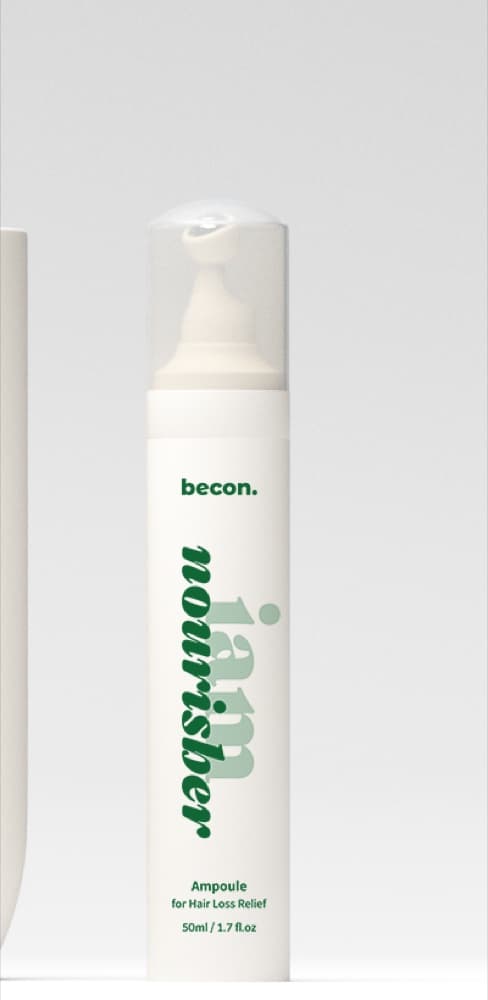
Quick answer: A scalp ampoule is a concentrated, leave-in liquid you apply directly to the skin of your scalp rather than to your hair. It is closer to a facial serum than to a conditioner — thin, fast-absorbing, and left in rather than rinsed out. Most are used once or twice a day on a clean, dry scalp.
If you have shopped Korean hair care, you have run into the word ampoule and probably assumed it was marketing. It is not, particularly. In Korean beauty an ampoule means a product with a higher concentration of active ingredients than the equivalent serum or essence, sold in a smaller bottle because you use less of it.
Applied to the scalp, that translates into something quite specific: a watery, fast-absorbing liquid you put on skin, not hair. And that last distinction is the one most people get wrong.
It goes on the scalp, not the hair
Almost everything else in your shower is designed for the hair shaft. Shampoo cleans it, conditioner coats it, oil smooths it. A scalp ampoule ignores the hair entirely. You are parting the hair to reach the skin underneath and treating that skin.
There is a reasonable case for treating it as skin, because that is what it is — and it is unusually active skin at that. Sebaceous gland density runs roughly 400 to 900 glands per square centimetre in the body's most oil-producing regions, and the scalp is among them, alongside the forehead and face. The scalp also carries the highest hair follicle density on the body. So it is skin that produces a great deal of oil, is densely punctuated by follicles, and spends its life under a layer of hair.
The practical upshot: a product designed to sit on that skin needs to be light enough not to make it greasy, and it needs to be left there long enough to matter.
Why the texture is watery
This is the part people notice first. A scalp ampoule feels closer to water than to any hair product — thin, slightly slippery, gone in a minute or two.
That is deliberate. Anything heavier sits on the scalp, mixes with the oil already there, and leaves hair looking dirty within hours. If a scalp treatment made your roots flat and greasy, you would stop using it by the third day, which makes the whole thing pointless. The thin texture is what allows daily use.
It also explains why ampoules come in small bottles. A 50ml bottle looks tiny next to a 500ml shampoo, but you are applying a few millilitres to a scalp, not a palmful to a head of hair. In practice one bottle lasts about a month at twice-daily use — so the small bottle is not a portion trick, it is a genuinely different rate of consumption.
Ampoule, tonic, oil, serum: what's the difference?
The categories blur, and brands are not consistent. Broadly:
- Scalp ampoule — highest concentration, watery or light gel, leave-in, applied to skin. Small bottle, daily use.
- Scalp tonic — usually thinner and more alcohol-forward, often with a cooling or astringent feel. Frequently overlaps with ampoules in practice.
- Scalp serum — in Korean formulation language, a step less concentrated than an ampoule. In Western marketing, often used interchangeably.
- Hair oil — treats the shaft and ends, not the skin. Applying it to the scalp is usually the opposite of what you want, especially if your scalp already runs oily.
If you take one distinction away, make it the last one. Hair oil and scalp ampoule get shelved together and do close to opposite jobs.
What the pH is doing
A lot of Korean scalp products advertise a mildly acidic pH, usually somewhere around 5. That is not arbitrary.
Skin maintains what dermatology literature calls the acid mantle — a slightly acidic film across the surface, generally cited in the 4.5 to 5.5 range, that supports normal barrier function. Reviews of skin surface pH describe an acidic value as important to stratum corneum maintenance and barrier function. Formulating a leave-on scalp product near that range is a way of not disrupting something that is already working.
Becon's formulas sit at pH 5.0–6.0, which is where that reasoning lands them.
How it actually feels to use
I use the Becon I am Nourisher ampoule, so here is the unglamorous version rather than the label version.
It has a roll-on applicator, not a dropper or a nozzle — you run it along the scalp in sections and then massage it in with your fingertips. That is easier than it sounds and considerably less messy than dropper bottles, which tend to run down your forehead if you are careless.
Apply it to a clean, dry scalp. After a shower, once your hair has dried, is the natural moment. On wet hair it dilutes and runs.
There is a cooling sensation — noticeable, refreshing, not sharp. It fades within a few minutes.
Crucially: it does not leave your hair greasy or wet-looking. You can use it in the morning before work. I use it twice a day because I shower morning and night, which is more than most people need — once daily is the ordinary case.
A 50ml bottle lasts me about a month at that pace, so probably closer to two months at once a day.
It has a roll-on applicator, not a dropper. You run it along the scalp in sections and massage it in — considerably less messy than droppers, which tend to run down your forehead.
How to use one
- Wash and dry your hair. The scalp should be clean and dry, not damp.
- Part the hair in sections so the applicator reaches skin rather than hair.
- Apply along each parting, working across the scalp.
- Massage in with fingertips for thirty seconds or so.
- Leave it. There is no rinsing step — that is the entire point of a leave-in.
Consistency matters more than quantity here. A small amount daily does more than a heavy application once a week.
A note on what scalp care can and cannot do
Scalp products are cosmetics. They can clean, exfoliate, hydrate, soothe surface irritation, and change how your scalp and hair look and feel. That is a genuinely useful set of things.
They are not medicines. If you have persistent flaking, itching, soreness, or noticeable hair loss, that is worth taking to a dermatologist rather than a shopping cart — those can have causes no cosmetic product addresses, and getting an actual diagnosis is faster than working through a shelf of products.
Frequently Asked Questions
Do you rinse a scalp ampoule out? No. It is a leave-in. Apply it to a clean, dry scalp and leave it there — rinsing removes the point of it.
Wet hair or dry hair? Dry. On a wet scalp the product dilutes and runs off before it absorbs. Wait until your hair has dried after washing.
Will it make my hair greasy? A well-formulated one will not. The texture is watery specifically so it can be used daily without weighing hair down. If a scalp product leaves your roots flat, it is too heavy for the job.
How often should I use it? Once a day suits most people. Twice is fine if you wash more often. Daily consistency matters more than the amount you apply.
How long does a bottle last? A 50ml bottle runs about a month at twice-daily use, so roughly two months for once-daily use.
Is an ampoule the same as a hair oil? No, and it is the distinction worth knowing. Hair oil treats the shaft and ends. An ampoule treats the skin of the scalp. If your scalp runs oily, hair oil applied there will make things worse.